 Add to Chrome
 Add to Firefox
 Add to Edge
Rethinking Positional Encoding for Neural Vehicle Routing
May 12, 2026
Transformer-based models have become the dominant paradigm for neural combinatorial optimization (NCO) of vehicle routing problems (VRPs), yet the role of positional encoding (PE) in these architectures remains largely unexplored. Unlike natural language, where tokens are uniformly spaced on a line, routing solutions exhibit several properties that render standard NLP positional encodings inadequate. In this work, we formalize three such structural properties that a routing-aware PE should respect, namely anisometric node distances, cyclic and direction-aware topology, and hierarchical depot-anchored global multi-route structure, combining them with a unifying design principle of geometric grounding. Guided by these criteria, we analyze and compare PE methods spanning NLP, graph-transformer, and routing-specific families, and propose a hierarchical anisometric PE that combines a distance-indexed, circularly consistent in-route encoding with a depot-anchored angular cross-route encoding. Extensive experiments across diverse VRP variants demonstrate that geometry-grounded PE consistently outperforms index-based alternatives, with gains that transfer across problem variants, model architectures, and distribution shifts.

EvoNav: Evolutionary Reward Function Design for Robot Navigation with Large Language Models
May 12, 2026Robot navigation is a crucial task with applications to social robots in dynamic human environments. While Reinforcement Learning (RL) has shown great promise for this problem, the policy quality is highly sensitive to the specification of reward functions. Hand-crafted rewards require substantial domain expertise and embed inductive biases that are difficult to audit or adapt, limiting their effectiveness and leading to suboptimal performance. In this paper, we propose EvoNav, an evolutionary framework that automates the design of robot navigation reward functions via large language models (LLMs). To overcome prohibitively costly policy training, EvoNav evaluates each candidate proposal from the LLM via a progressive three-stage warm-up-boost procedure. EvoNav advances from analytical proxies with low-cost surrogates, such as small datasets and analytic rules, to lightweight rollouts and, finally, to full policy training, enabling computationally efficient exploration under effective feedback. Experiment results show that EvoNav produces more effective navigation policies than manually designed RL rewards and state-of-the-art reward design methods.
POP: Online Structural Pruning Enables Efficient Inference of Large Foundation Models
Feb 06, 2026Large foundation models (LFMs) achieve strong performance through scaling, yet current structural pruning methods derive fixed pruning decisions during inference, overlooking sparsity patterns that emerge in the autoregressive token generation. In this paper, we propose POP (Partition-guided Online Pruning), an efficient online structural pruning framework that enables context-conditioned dynamic pruning with minimal computational overhead. POP partitions model channels into retained, candidate, and pruned regions, where prefilling defines a coarse pruning partition, and the decoding stage generates a fine-grained mask within the candidate region, avoiding full-channel re-evaluation. The coarse pruning partition preserves consistently important weights, while the fine-grained masking provides context-conditioned variation during decoding. Moreover, POP is a lightweight, plug-and-play method that requires no preprocessing, including offline calibration, retraining, or learning predictors. Extensive evaluations across diverse LFMs, including large language models (LLMs), mixture-of-experts models (MoEs), and vision-language models (VLMs), demonstrate that POP consistently delivers higher accuracy than existing pruning approaches while incurring smaller computational overhead and minimizing inference latency.
JudgeFlow: Agentic Workflow Optimization via Block Judge
Jan 12, 2026Optimizing LLM-based agentic workflows is challenging for scaling AI capabilities. Current methods rely on coarse, end-to-end evaluation signals and lack fine-grained signals on where to refine, often resulting in inefficient or low-impact modifications. To address these limitations, we propose {\our{}}, an Evaluation-Judge-Optimization-Update pipeline. We incorporate reusable, configurable logic blocks into agentic workflows to capture fundamental forms of logic. On top of this abstraction, we design a dedicated Judge module that inspects execution traces -- particularly failed runs -- and assigns rank-based responsibility scores to problematic blocks. These fine-grained diagnostic signals are then leveraged by an LLM-based optimizer, which focuses modifications on the most problematic block in the workflow. Our approach improves sample efficiency, enhances interpretability through block-level diagnostics, and provides a scalable foundation for automating increasingly complex agentic workflows. We evaluate {\our{}} on mathematical reasoning and code generation benchmarks, where {\our{}} achieves superior performance and efficiency compared to existing methods. The source code is publicly available at https://github.com/ma-zihan/JudgeFlow.
VRPAgent: LLM-Driven Discovery of Heuristic Operators for Vehicle Routing Problems
Oct 08, 2025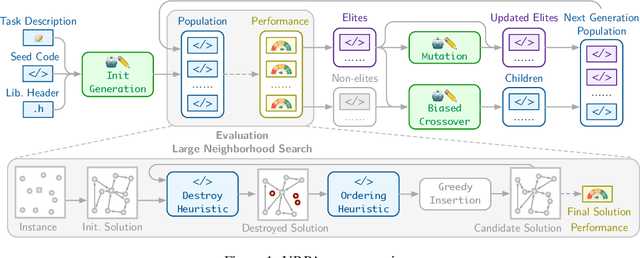
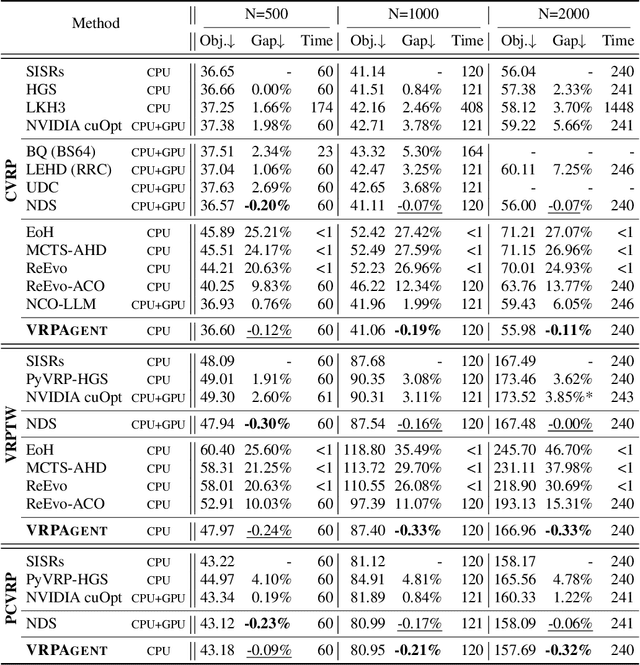
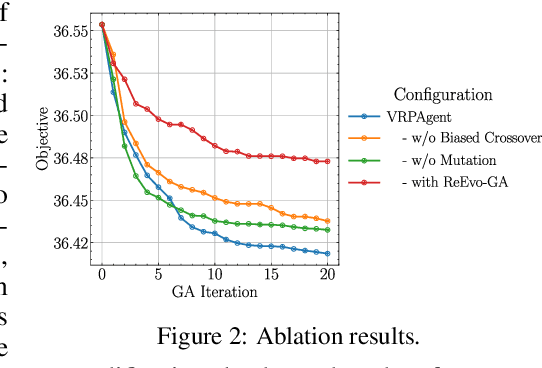
Designing high-performing heuristics for vehicle routing problems (VRPs) is a complex task that requires both intuition and deep domain knowledge. Large language model (LLM)-based code generation has recently shown promise across many domains, but it still falls short of producing heuristics that rival those crafted by human experts. In this paper, we propose VRPAgent, a framework that integrates LLM-generated components into a metaheuristic and refines them through a novel genetic search. By using the LLM to generate problem-specific operators, embedded within a generic metaheuristic framework, VRPAgent keeps tasks manageable, guarantees correctness, and still enables the discovery of novel and powerful strategies. Across multiple problems, including the capacitated VRP, the VRP with time windows, and the prize-collecting VRP, our method discovers heuristic operators that outperform handcrafted methods and recent learning-based approaches while requiring only a single CPU core. To our knowledge, \VRPAgent is the first LLM-based paradigm to advance the state-of-the-art in VRPs, highlighting a promising future for automated heuristics discovery.
TrajEvo: Trajectory Prediction Heuristics Design via LLM-driven Evolution
Aug 07, 2025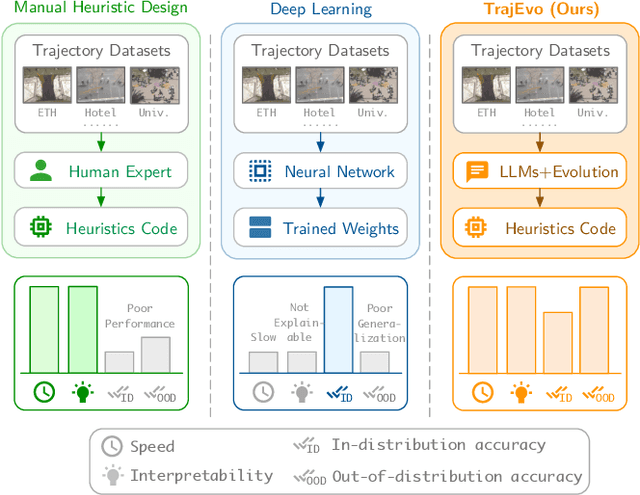
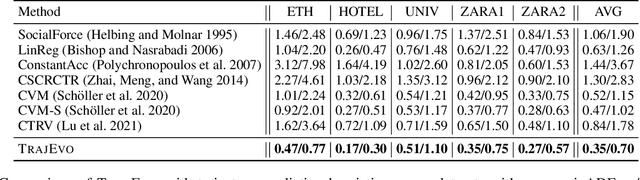
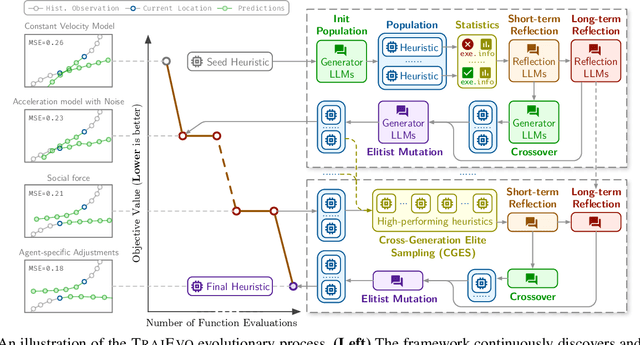
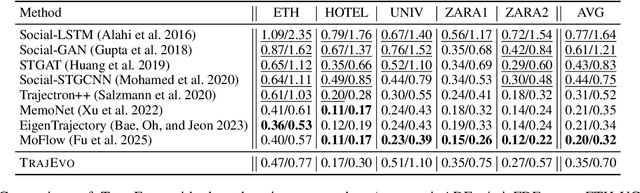
Trajectory prediction is a critical task in modeling human behavior, especially in safety-critical domains such as social robotics and autonomous vehicle navigation. Traditional heuristics based on handcrafted rules often lack accuracy and generalizability. Although deep learning approaches offer improved performance, they typically suffer from high computational cost, limited explainability, and, importantly, poor generalization to out-of-distribution (OOD) scenarios. In this paper, we introduce TrajEvo, a framework that leverages Large Language Models (LLMs) to automatically design trajectory prediction heuristics. TrajEvo employs an evolutionary algorithm to generate and refine prediction heuristics from past trajectory data. We propose two key innovations: Cross-Generation Elite Sampling to encourage population diversity, and a Statistics Feedback Loop that enables the LLM to analyze and improve alternative predictions. Our evaluations demonstrate that TrajEvo outperforms existing heuristic methods across multiple real-world datasets, and notably surpasses both heuristic and deep learning methods in generalizing to an unseen OOD real-world dataset. TrajEvo marks a promising step toward the automated design of fast, explainable, and generalizable trajectory prediction heuristics. We release our source code to facilitate future research at https://github.com/ai4co/trajevo.
BuildEvo: Designing Building Energy Consumption Forecasting Heuristics via LLM-driven Evolution
Jul 16, 2025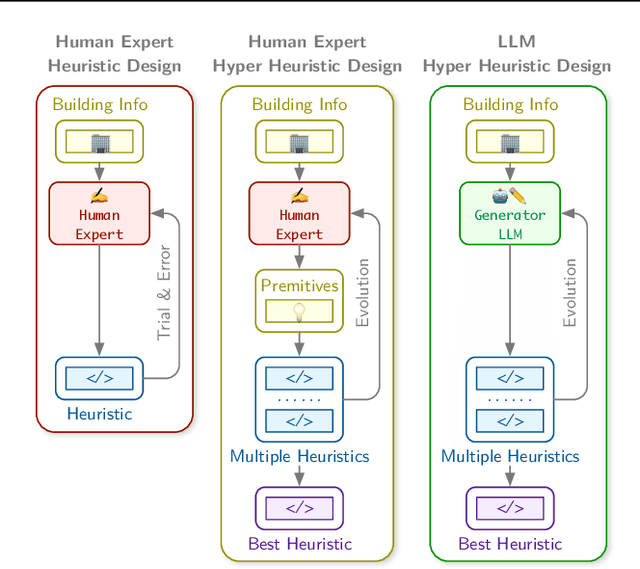
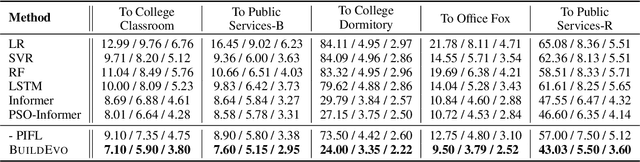
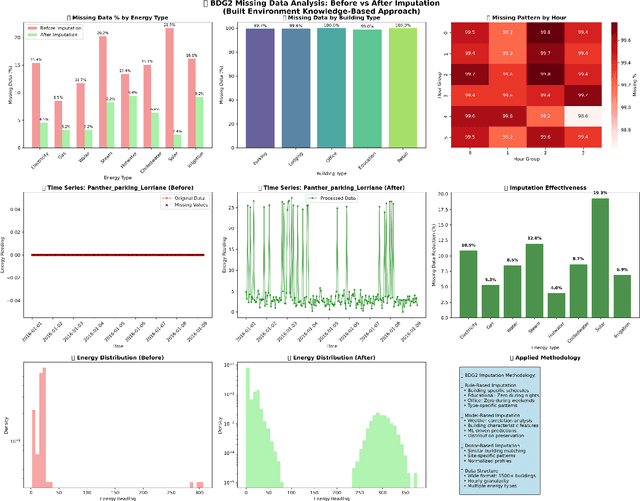
Accurate building energy forecasting is essential, yet traditional heuristics often lack precision, while advanced models can be opaque and struggle with generalization by neglecting physical principles. This paper introduces BuildEvo, a novel framework that uses Large Language Models (LLMs) to automatically design effective and interpretable energy prediction heuristics. Within an evolutionary process, BuildEvo guides LLMs to construct and enhance heuristics by systematically incorporating physical insights from building characteristics and operational data (e.g., from the Building Data Genome Project 2). Evaluations show BuildEvo achieves state-of-the-art performance on benchmarks, offering improved generalization and transparent prediction logic. This work advances the automated design of robust, physically grounded heuristics, promoting trustworthy models for complex energy systems.
AoP-SAM: Automation of Prompts for Efficient Segmentation
May 17, 2025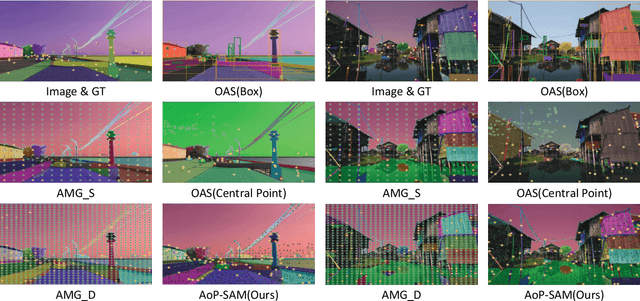
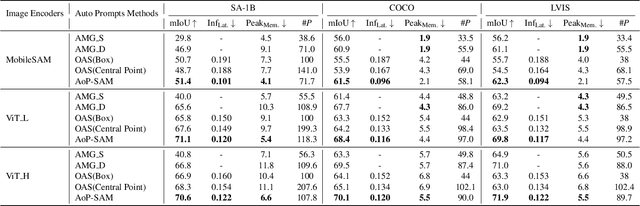
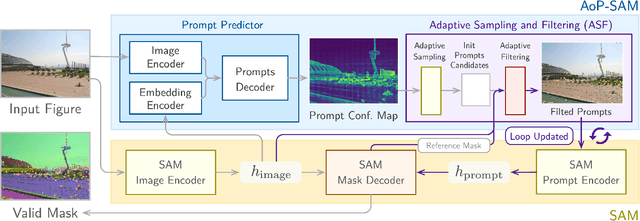

The Segment Anything Model (SAM) is a powerful foundation model for image segmentation, showing robust zero-shot generalization through prompt engineering. However, relying on manual prompts is impractical for real-world applications, particularly in scenarios where rapid prompt provision and resource efficiency are crucial. In this paper, we propose the Automation of Prompts for SAM (AoP-SAM), a novel approach that learns to generate essential prompts in optimal locations automatically. AoP-SAM enhances SAM's efficiency and usability by eliminating manual input, making it better suited for real-world tasks. Our approach employs a lightweight yet efficient Prompt Predictor model that detects key entities across images and identifies the optimal regions for placing prompt candidates. This method leverages SAM's image embeddings, preserving its zero-shot generalization capabilities without requiring fine-tuning. Additionally, we introduce a test-time instance-level Adaptive Sampling and Filtering mechanism that generates prompts in a coarse-to-fine manner. This notably enhances both prompt and mask generation efficiency by reducing computational overhead and minimizing redundant mask refinements. Evaluations of three datasets demonstrate that AoP-SAM substantially improves both prompt generation efficiency and mask generation accuracy, making SAM more effective for automated segmentation tasks.
USPR: Learning a Unified Solver for Profiled Routing
May 08, 2025The Profiled Vehicle Routing Problem (PVRP) extends the classical VRP by incorporating vehicle-client-specific preferences and constraints, reflecting real-world requirements such as zone restrictions and service-level preferences. While recent reinforcement learning (RL) solvers have shown promise, they require retraining for each new profile distribution, suffer from poor representation ability, and struggle to generalize to out-of-distribution instances. In this paper, we address these limitations by introducing USPR (Unified Solver for Profiled Routing), a novel framework that natively handles arbitrary profile types. USPR introduces three key innovations: (i) Profile Embeddings (PE) to encode any combination of profile types; (ii) Multi-Head Profiled Attention (MHPA), an attention mechanism that models rich interactions between vehicles and clients; (iii) Profile-aware Score Reshaping (PSR), which dynamically adjusts decoder logits using profile scores to improve generalization. Empirical results on diverse PVRP benchmarks demonstrate that USPR achieves state-of-the-art results among learning-based methods while offering significant gains in flexibility and computational efficiency. We make our source code publicly available to foster future research at https://github.com/ai4co/uspr.
TrajEvo: Designing Trajectory Prediction Heuristics via LLM-driven Evolution
May 07, 2025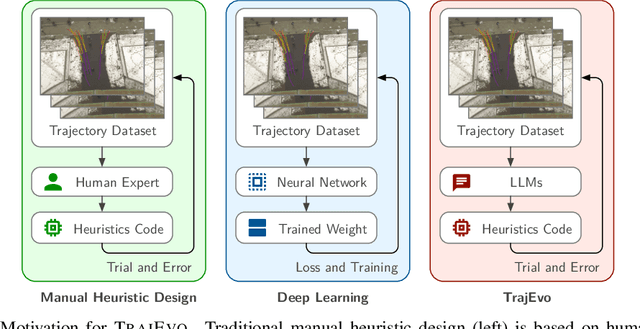
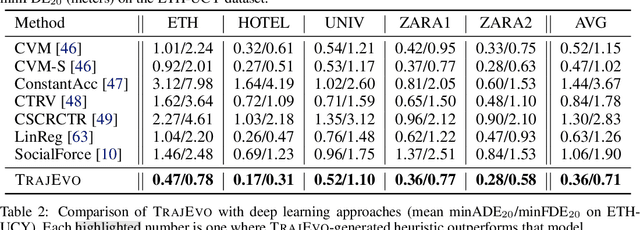
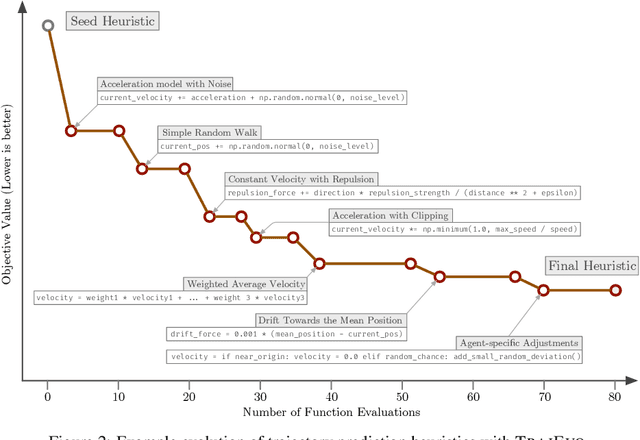
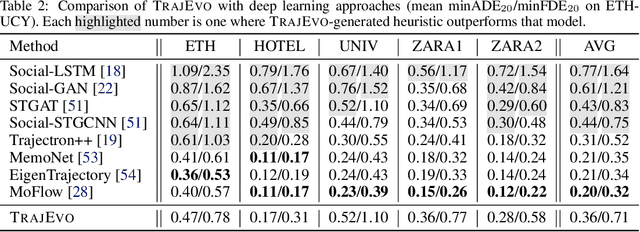
Trajectory prediction is a crucial task in modeling human behavior, especially in fields as social robotics and autonomous vehicle navigation. Traditional heuristics based on handcrafted rules often lack accuracy, while recently proposed deep learning approaches suffer from computational cost, lack of explainability, and generalization issues that limit their practical adoption. In this paper, we introduce TrajEvo, a framework that leverages Large Language Models (LLMs) to automatically design trajectory prediction heuristics. TrajEvo employs an evolutionary algorithm to generate and refine prediction heuristics from past trajectory data. We introduce a Cross-Generation Elite Sampling to promote population diversity and a Statistics Feedback Loop allowing the LLM to analyze alternative predictions. Our evaluations show TrajEvo outperforms previous heuristic methods on the ETH-UCY datasets, and remarkably outperforms both heuristics and deep learning methods when generalizing to the unseen SDD dataset. TrajEvo represents a first step toward automated design of fast, explainable, and generalizable trajectory prediction heuristics. We make our source code publicly available to foster future research at https://github.com/ai4co/trajevo.